
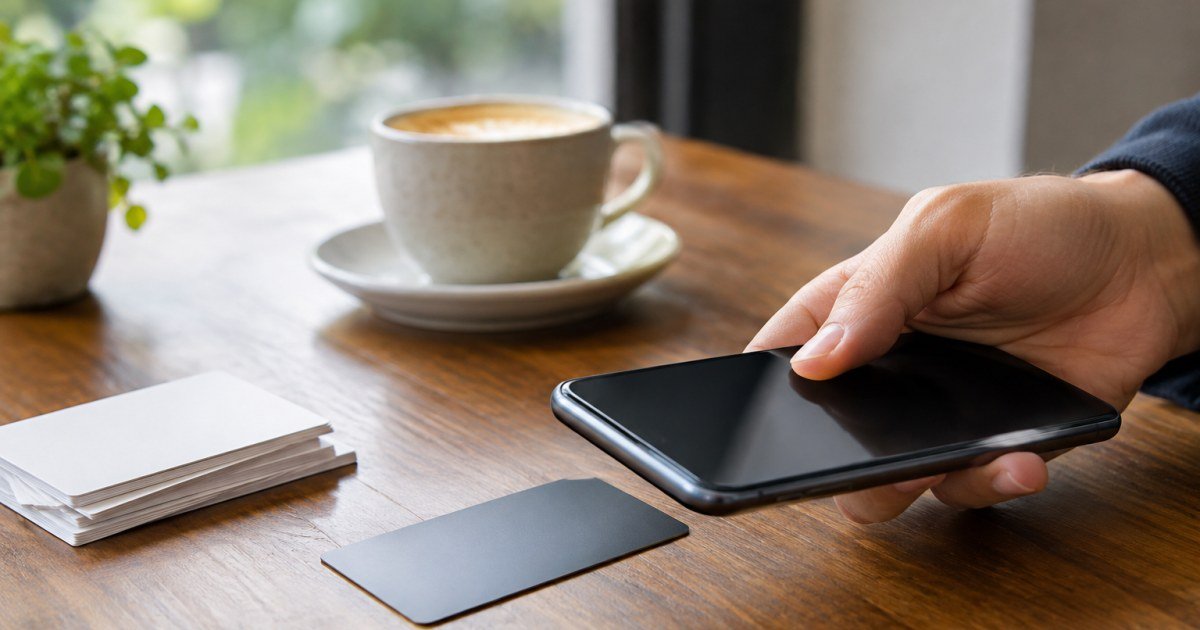
If you're deciding between another box of paper cards and an NFC business card, you're asking the right question at the right moment. The handshake hasn't changed — but what happens after it has. A digital business card is a card, phone grip, or wristband with a small NFC chip inside: someone taps their phone against it and your contact details, links, and booking page open on their screen instantly, with nothing to type and no app to install. Paper still has a place, and we'll be honest about where. But for most professionals and small-business owners in 2026, the comparison isn't as close as it used to be. Here's the full breakdown — cost over time, what actually happens to your card after you hand it over, what each option can share, and when paper genuinely wins.
What Is an NFC Business Card, Exactly?
NFC stands for near-field communication — the same short-range technology behind tap-to-pay. An NFC business card has a small chip inside that's linked to your digital profile. When someone holds their phone near it, the profile opens in their browser automatically. Nearly every iPhone and Android released in the last several years reads NFC out of the box, and a printed QR code on the device acts as a backup for anything that doesn't.
The important part is that the physical card is just the pointer. Your actual information lives in the profile, which you can edit any time. Change your phone number, add a new service, update your title — the same card keeps working, always current. That single fact drives most of the comparison below. If you want to see the tap-to-profile flow step by step, the how it works page walks through it.
Cost Over Time: One Smart Business Card vs. Endless Reprints
Paper looks cheap because you price it per box. But paper is a recurring cost that never stops. New phone number? Reprint. New role or logo? Reprint. Moved offices, added a service, changed your email? Reprint. Ran out the week of a big event? Rush reprint. Multiply that across every person on your team and every change your business makes, and the "cheap" option quietly becomes the expensive one — with half-used boxes of outdated cards sitting in drawers as the receipt.
A smart business card flips that math. You buy the device once. When your information changes, you edit your profile from your phone or the web editor, and the card in your pocket is instantly up to date. There's no version two to order and no stack of stale cards to recycle. There's an environmental upside too, though we won't oversell it: many handed-out paper cards are discarded within days, and every update means printing more coated cardstock. One device you edit forever simply produces less waste.
What Happens After the Handshake
This is where paper loses most of its value, and it has nothing to do with technology. Think about the last paper card someone gave you. Where is it now? Pocket, car console, the pile on the desk — or the recycling bin. Everyone knows the pattern from their own behaviour: paper cards get lost, and even the ones that survive require the other person to dig the card out and type your details into their phone before they can actually reach you.
An NFC tap skips all of that. The other person's phone opens your profile on the spot, and one button saves you straight to their contacts — name, number, email, company, website. You're in their phone before the conversation ends, in the one place they'll actually look when they need you. And because a digital business card never "runs out," you're never the person at the event apologizing for forgetting your cards.
A Digital Business Card Shares More Than a Name
A paper card carries maybe eight lines of static text. An electronic business card opens a full profile you control, which changes what a first meeting can accomplish. A Popsociables profile can hold:
- Contact details with one-tap save-to-contacts
- Social links — Instagram, LinkedIn, TikTok, YouTube, and more
- Website and store links to wherever you want people to go next
- Photo galleries and video — a portfolio that travels with you
- Booking, so "we should set something up" becomes an actual appointment
- Contact forms that capture the other person's details for you
- Review links that send happy customers straight to your Google review page
The review link deserves its own mention
For trades, salons, restaurants, realtors — any business that lives on reviews — this alone can justify the switch. Instead of asking a satisfied customer to "look us up on Google later," you hand them the moment: tap the card, tap the review link, done while the goodwill is still warm.
For teams, it scales
Popsociables business plans give a company a master business profile plus individual profiles for each employee, with device management, lead capture, bookings, and analytics in one place. A car dealership, for example, can give every salesperson a device that opens their own profile, while unassigned devices open the business master profile. Try doing that with a print order.
Analytics: Know Your Card Was Actually Used
Hand out a hundred paper cards and you learn precisely nothing. Did anyone keep one? Call because of one? Silence. A digital business card closes that loop: you can see when your profile is being viewed and tapped, so you know whether your networking is actually landing. For businesses, team analytics show which employees' profiles are getting attention and which devices are producing leads — the difference between "we handed out cards at the trade show" and knowing exactly how many profile views and new contacts the trade show produced.
When Paper Business Cards Still Make Sense
An honest comparison cuts both ways. Paper still earns its place in a few situations:
- Mass seeding. If your plan is to leave stacks on counters or drop hundreds into a fishbowl, paper's per-unit cost wins. NFC is built for conversations, not confetti.
- The keepsake card. A beautifully printed, heavy-stock card can be a deliberate brand statement for luxury services — an object meant to be kept, not just information transfer.
- No-phone settings. Some job sites, secure facilities, and formal settings make pulling out a phone awkward or impossible.
- Personal preference. A few contacts simply like paper, and meeting people where they are is good manners.
None of these are most people's daily reality, and the QR backup on every Popsociables device covers most edge cases anyway. Many professionals land on a hybrid: an NFC device for real conversations, a small reserve of paper for everything else.
Choosing a Digital Business Card in Canada
If you're shopping for a digital business card in Canada, it's worth picking a format you'll actually have on you. Popsociables is a Canadian company based in Cranbrook, BC — serving the East Kootenays, including Kimberley, Fernie, and Creston, and shipping across Canada with prices in CAD. Three form factors cover most people:
- The Popsociables Grip — an NFC-enabled phone grip that looks and works like the collapsible grips you already know (think PopSockets), helping you hold your phone and doubling as a stand, with the chip and QR backup built in. Because it lives on your phone, it's the one networking tool you physically can't forget at home.
- NFC business cards — the classic card format, upgraded with a tap.
- NFC wristbands — wearable and hands-free, great for events and active work.
All three open the same kind of editable profile, so your information never goes out of date no matter which one you carry. Browse the full lineup on the Popsociables products page, and if you're not sure which format fits your work — or you're outfitting a whole team — get in touch and we'll help you sort it out. The next card you hand someone shouldn't end up in a drawer. It should end up in their phone.